
Baseball Books, Spring 2026

I am, almost exclusively, a reader of fiction.
I can’t explain this, and I am not proud of it. I am sensitive to those who say, “The real world is so interesting, why do you waste your time on make-believe?”
Maybe I prefer fiction because it’s where I find the best writing. Maybe it’s because I spend so much time reading medical studies that fiction is an escape. Non-fiction books often disappoint me because they seem like they could just as well have been a New Yorker article.1 Most of my non-fiction consumption comes in the form of podcasts.
The exception to my aversion to non-fiction is baseball books. Not to sound like too much of a hyper-regimented obsessive, but for years, I’ve made it a habit to read a baseball book every spring.2
This spring, for no particular reason, I read three baseball books. Two of the books were fiction, read for two separate book clubs. (Yes, I picked them both, and yes, I remain a member in good standing of both clubs). The third book, a non-fiction epic, was a gift from a former teammate. The books were so different that I thought it would be fun to get my thoughts on paper (or, I guess, in the cloud).
The Universal Baseball Association, Inc., J. Henry Waugh, Prop.; Robert Coover, 1968
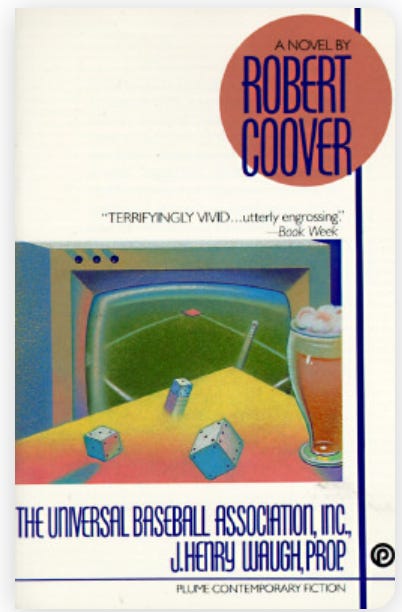
This is a book that I respected a whole lot more than I enjoyed. It’s a novel about J. Henry Waugh, a man who creates The Universal Baseball Association. The association is based on a tabletop baseball game, think Strat-O-Matic, but with dozens of layers of complexity. The league is a mind-boggling creation in its 56th year. The records and history include generations of players, coaches, managers, family members, singers, and politicians. The creation is so impressive that readers have suggested that the abbreviation of the protagonist’s name, JHWh is a stand-in for YHWH, the Hebrew name for God.
The league becomes an all-consuming alternate reality for Henry, both enriching and ruining his life. He deeply loves the Universal Baseball Association, but it is isolating. The writing reminded me of On the Road; I felt out of breath while reading some passages. There are sections in which Henry’s reality and fantasy run in tandem: he is in a bar with a friend, but also imagines the players from his imaginary league there too. It is an impressive work, putting the reader in the mind of someone barely keeping it together. It is also, at times, unpleasant to read. Worse than unpleasant, there are sections I found unreadable.
No spoilers here, except to say that the only comparison I can make for the final section is the denouement of 2001. I honestly don’t know if this should make you want to read it or aggressively avoid it
The book barely makes the cut as a baseball book. The original New York Times review contains the spectacular line suggesting:
…not to read it because you don’t like baseball is like not reading Balzac because you don’t like boarding houses.
Hell, not even Henry liked baseball that much. This is how his creation of the game is described:
And so, finally, he’d found his way back to baseball. Nothing like it really. Not the actual game so much—to tell the truth, real baseball bored him—but rather the records, the statistics, the peculiar balances between individual and team, offense and defense, strategy and luck, accident and pattern, power and intelligence. And no other activity in the world had so precise and comprehensive a history, so specific an ethic, and at the same time, strange as it seemed, so much ultimate mystery.
What I admired most about the book was how prescient it felt. Coover saw into the future, our present, of fantasy sports leagues and people creating artificial worlds for themselves online. Like many fantasy football fanatics who spend hours listening to sports radio, Henry’s Universal Baseball Association is a remarkable creation that brings him joy and ruins his life.
My Goodreads rating: 3/5
The Baseball 100; Joe Posnanski, 2021
The Baseball 100 is an amazing accomplishment, coming in at 830 pages. It is an ordered list of the 100 best players in baseball history. It is, of course, filled with detailed statistics and memorable stories. It also gave me, a bit of a baseball history enthusiast, a whole new way of thinking about the effect that pre-1947 segregation had on baseball. It is funny, and joyous, and full of love.
Posnanski’s work is remarkable because the idea of ranking 100 players and writing about them promises a terrible book. You could imagine repetitive chapters about players’ accomplishments and inane arguments about why the author chose to rank Rod Carew #57, Tom Seaver #41, and Jimmy Foxx #23.
In fact, the book is nothing of the sort. Posnanski admits, right off the bat, that the rankings are a bit silly. He does this when he discusses his ranking of Ichiro Suzuki at 100.
There is no doubt that by ranking him 100, I have managed to infuriate two different camps. There are those who see Ichiro’s lack of power…, his bland .355 on-base percentage, and his good-but-not-great WAR and think he has no business being listed among the 100 greatest players ever.
Then there are those who see a guy with 3,000 hits who ran the bases about as well as anyone ever and was also one of the greatest defensive right fielders in baseball history—people who delighted in the wonder that was Ichiro Suzuki-and they ask, “How could there possibly be 99 players better than him?”
The chapters are as varied as the players themselves. Reading the book, you learn about all the quirks of the players, where they excelled, and how they could have been even greater. In the 100, there are at least two dozen stories worthy of Greek tragedies.
The way he deals with the Negro Leagues is both sensitive and eye-opening. He writes forcefully about how segregation cheapened both leagues. He paints pictures of inarguably great but barely known Negro League players using legends, primary press sources, quotations from major league contemporaries, and the statistics pieced together in recent years by Seamheads.
He ranks Oscar Charleston at number five, following Mays, Ruth, Bonds, and Aaron. His discussion gives you a sense of how he deals with the race issue.
I want you to feel the fury of this ranking, feel it down deep. I want you to think, if you are so inclined, “Look, I’m sure he was terrific, but there’s no possible way that Oscar Charleston, who played in a struggling league 100 years ago, could possibly be the fifth greatest player of all time.”
Or I want you to think, “Fifth greatest? That’s ridiculous. He should be No. 1!”
Or I want you to think, “This is pure political correctness. We have almost no stats on Charleston. We have only a handful of quotes about him. You can’t rank someone this high on the list based on a few crusty legends and myths.”
Or I want you to think, “It’s such an infuriating tragedy that we as an entire nation never got to see the greatest player in the history of baseball.”
Or I want you to think, “How is it that I’ve never even heard of this guy?”
My Goodreads rating 5/5
The Natural; Bernard Malamud, 1952
The Natural reminds me of A River Runs Through It. Not because they both end up as films featuring Robert Redford, but because I don’t really understand how either became an American classic. It’s probably unsurprising, therefore, that I like the movie versions more than I like the books, even though, or maybe because, they stray far from the books. (Robert Redford famously had to wait until Norman Maclean was dead before he could adapt A River Runs Through It.)
The plot of The Natural is great, but the book is all over the place. It pokes fun at the tropes of dashed-off baseball novels written for tween boys in the ‘50s and ‘60s. (Yes, I once read some of these books…) Malamud borrows stories from many actual baseball greats. It was fun to read this book after reading The Baseball 100, which helped me identify the biographies being channeled – Babe Ruth, Joe Jackson, Ted Williams, among them.
Roy Hobbs, the protagonist, who becomes a worship-worthy Redford in the 1984 film, is the archetype of a flawed character. He’s a prodigy whose career is derailed by a targeted (at the last minute) assault. I’m programmed to root for him as he tries to fight his way back to the top. But he is a self-absorbed, bitter, greedy, womanizing jerk who, in the end, I didn’t really care if he wins or loses.
One of my favorite baseball novels is Shoeless Joe by W.P. Kinsella. This is the book that inspired Field of Dreams. Unlike The Natural, it’s kind of a toss-up whether I like the Shoeless Joe or Field of Dreams more. (By the way, I also deeply love the other Kevin Costner movies, Bull Durham and For Love of the Game). I bring up Shoeless Joe because The Natural manages to equal it in the absurd shallowness of the female characters.
My Goodreads rating 3/5
This is not the case for Ending Medical Reversal, which needed absolutely every single work to make its point.
Here is a list of many that I can remember, complete with an AI-generated summary.
Curious.Have you read the Art of Fielding?
I can’t explain it but although I’m not much of a baseball fan I love baseball movies. The ones you mentioned are some of my all time favourites. Go Jays!!